셜록 홈즈의 모험 학습자료 — AP English·SAT Reading·추리소설 close reading
영어 원문을 근거로 관찰, 자료, 변장, 서술자, 빅토리아 시대 사회를 분석하는 실전 학습 가이드입니다.
이 학습자료는 미국식 문학 독해와 영어 에세이 작성을 목표로 합니다. 작품 전체 흐름을 먼저 잡고 싶다면 본문 해설을 먼저 읽어도 좋습니다.
이 자료의 목표
『셜록 홈즈의 모험』은 단편집이라서 장편 소설처럼 하나의 큰 플롯만 외우면 부족합니다. 미국식 문학 수업에서는 각 사건의 결말보다, 반복되는 추리 구조와 서술 방식이 어떤 의미를 만드는지 묻습니다.
이 자료는 세 가지를 훈련합니다.
- 영어 원문에서 observation, data, fact, disguise 같은 핵심 단어가 어떻게 작동하는지 읽기
- 왓슨의 1인칭 서술이 독자의 시야를 어떻게 제한하고 조절하는지 설명하기
- AP Lit / SAT Reading / IB English / 미국 학교 essay에서 단편집을 하나의 컬렉션으로 분석하기
1. 빠른 복습
- 원제: The Adventures of Sherlock Holmes
- 저자: Arthur Conan Doyle
- 단행본 출간: 1892년
- 형식: 열두 편의 단편
- 서술자: Dr. John Watson
- 핵심 방법: 이론보다 관찰, 극적인 설명보다 세부 증거
- 자주 나오는 시험 포인트: 탐정의 방법, 제한된 서술, 변장, 가정 내부의 위험, 계급과 젠더, 사적 정의
한 문장 요약:
Sherlock Holmes solves twelve cases by turning overlooked details into evidence, but Doyle uses those cases to expose the social pressures hidden inside Victorian respectability.
한국어로 이해하면: 홈즈는 작은 단서로 사건을 해결하지만, 단편집 전체는 빅토리아 시대의 결혼, 돈, 계급, 고용, 가정 권력이 어떻게 범죄를 가능하게 하는지 보여 줍니다.
2. 시험용 컬렉션 구조
반복되는 시작 패턴
대부분의 이야기는 왓슨의 회상, 베이커가의 일상, 또는 기묘한 의뢰인의 등장으로 시작합니다. 이 구조는 독자를 왓슨의 위치에 놓습니다. 우리는 홈즈보다 적게 알고, 홈즈처럼 보려고 노력합니다.
사건 전개
의뢰인의 이야기는 대개 감정적으로 강하지만 불완전합니다. 홈즈는 그 증언을 바로 믿지 않고, 물건과 공간과 행동을 함께 읽습니다. 「빨간 머리 연맹」의 광고, 「얼룩 끈」의 방 구조, 「푸른 홍옥」의 모자가 대표적입니다.
반전
반전은 "새로운 정보"보다 "이미 있던 정보의 재배열"에서 나옵니다. 독자는 단서를 보았지만 관찰하지 못했습니다. 이 차이가 홈즈 단편의 시험 포인트입니다.
해결과 윤리적 여운
홈즈의 설명은 사건을 정리하지만, 정의를 완전히 보장하지는 않습니다. 존 오픈쇼는 죽고, 라이더는 풀려나며, 메리 서덜랜드는 진실을 받아들이지 못할 수 있습니다. 결말의 윤리적 불완전성을 분석하면 좋은 에세이가 됩니다.
3. 핵심 원문 구절 읽기
아래 구절은 외울 명문장이 아니라 close reading의 재료입니다. 짧은 문장을 읽을 때도 장면, 말하는 사람, 단어 선택, 문장 리듬, 컬렉션 전체의 반복 주제를 함께 보세요.
Passage 1: see and observe
You see, but you do not observe. The distinction is clear.
맥락: 「보헤미아 왕국의 스캔들」에서 홈즈가 왓슨에게 계단 수를 예로 들며 관찰과 단순한 시각 경험의 차이를 설명합니다.
Close reading: see와 observe의 대비는 홈즈식 추리의 핵심입니다. 같은 장면을 보아도 무엇을 기억하고 의미화하는지가 다릅니다.
에세이 활용: 왓슨의 제한된 시야, 독자의 훈련, 탐정소설의 clue 구조를 설명할 때 쓸 수 있습니다.
Passage 2: data before theory
It is a capital mistake to theorise before one has data.
맥락: 홈즈가 사건을 듣기 전부터 결론을 만들려는 태도를 경계하는 장면입니다.
Close reading: capital mistake는 단순한 조언이 아니라 지적 윤리의 경고처럼 들립니다. data는 홈즈가 추리를 감상이 아니라 증거의 배열로 생각한다는 점을 보여 줍니다.
에세이 활용: 홈즈의 과학적 태도와 그 한계를 함께 분석할 수 있습니다. 그는 자료를 강조하지만, 어떤 자료를 중요하게 보는지는 사회적 직관과 경험에 의존합니다.
Passage 3: little things
It has long been an axiom of mine that the little things are infinitely the most important.
맥락: 「신랑의 정체」에서 홈즈가 사소해 보이는 외양과 편지의 특징을 중요하게 다룹니다.
Close reading: axiom은 홈즈의 방법이 우연한 습관이 아니라 원칙임을 보여 줍니다. little things와 infinitely의 결합은 작은 단서가 끝없는 의미를 열 수 있음을 강조합니다.
에세이 활용: 모자, 환기구, 타자기, 머리카락, 발자국처럼 작은 물건이 플롯을 움직이는 방식을 설명할 때 좋습니다.
Passage 4: obvious fact
There is nothing more deceptive than an obvious fact.
맥락: 「보스콤 계곡의 비밀」에서 모두가 제임스 매카시를 범인으로 보는 상황을 홈즈가 의심합니다.
Close reading: obvious와 deceptive가 충돌합니다. 명백함은 진실의 보증이 아니라, 생각을 멈추게 하는 장치가 될 수 있습니다.
에세이 활용: 오답 제거형 SAT 문제나 AP 에세이에서 "appearance versus reality"를 구체적으로 설명할 때 유용합니다.
Passage 5: business to know
My name is Sherlock Holmes. It is my business to know what other people don’t know.
맥락: 「푸른 홍옥」에서 홈즈가 정보와 전문성의 힘을 자신 있게 드러내는 장면입니다.
Close reading: business는 직업, 임무, 거래의 의미를 동시에 가집니다. 홈즈의 지식은 취미가 아니라 사회적으로 기능하는 전문 노동입니다.
에세이 활용: 홈즈를 근대 전문직 인물로 분석하거나, 지식과 권력의 관계를 설명할 때 쓸 수 있습니다.
Passage 6: violence recoils
Violence does, in truth, recoil upon the violent, and the schemer falls into the pit which he digs for another.
맥락: 「얼룩 끈」에서 로일롯의 계략이 자신에게 돌아간 뒤 홈즈가 내리는 도덕적 정리입니다.
Close reading: recoil과 falls는 폭력이 되돌아오는 물리적 움직임을 만듭니다. 추리의 결말이 윤리적 우화처럼 읽히는 순간입니다.
에세이 활용: 단편의 moral closure, domestic Gothic, 사적 정의의 만족감과 한계를 함께 분석할 수 있습니다.
Passage 7: bricks without clay
Data! data! data! I can’t make bricks without clay.
맥락: 「너도밤나무 집」에서 홈즈가 바이올렛 헌터의 사건을 더 판단하기 전에 자료가 필요하다고 말합니다.
Close reading: 반복되는 Data!는 홈즈의 지적 조급함을 보여 주면서도 원칙을 강조합니다. 벽돌과 진흙의 비유는 추리가 재료 없이 만들어질 수 없다는 뜻입니다.
에세이 활용: 단편집 전체의 detective method를 압축하는 구절로 사용할 수 있습니다. 단서가 모이기 전에는 홈즈도 완성된 설명을 만들지 않습니다.
4. Close Reading: 홈즈식 관찰을 문학 분석으로 바꾸기
홈즈 단편을 close reading할 때 핵심은 "단서를 많이 찾기"가 아니라, 어떤 세부가 왜 단서가 되는지 설명하는 것입니다. 같은 정보를 보아도 왓슨은 사건의 분위기와 의뢰인의 감정을 먼저 전달하고, 홈즈는 그 정보가 동기, 기회, 공간 구조와 어떻게 연결되는지 판단합니다. 따라서 좋은 답안은 줄거리 재현에서 멈추지 않고 관찰된 사실 -> 해석 -> 작품 전체 의미의 순서로 움직여야 합니다.
1단계: 누가 보고 있는지 확인하기
홈즈 단편은 대부분 왓슨이 기록합니다. 왓슨은 친절하고 믿을 만하지만, 홈즈만큼 관찰하지 못합니다. 따라서 지문을 읽을 때 "사건 자체"와 "왓슨이 사건을 보여 주는 방식"을 구분해야 합니다.
예를 들어 왓슨은 계단을 매일 오르내리지만 계단 수를 기억하지 못합니다. 이 장면은 왓슨이 무능하다는 뜻이 아니라, 독자의 기본 위치를 보여 줍니다. 독자도 왓슨처럼 정보를 받지만 아직 정보의 중요도를 나누지 못합니다. 에세이에서는 "Watson is less intelligent"보다 "Watson's narration makes the reader experience the gap between seeing and interpreting"처럼 써야 합니다.
2단계: 이상함의 기능을 묻기
빨간 머리만 뽑는 연맹, 결혼식 날 사라진 신랑, 종이 울리지 않는 줄, 거위 속 보석은 모두 기이합니다. 좋은 답안은 "이상하다"에서 멈추지 않고, 그 이상함이 누구에게 이익을 주는지 설명합니다.
「빨간 머리 연맹」의 광고는 코미디처럼 보이지만, 실제 기능은 윌슨을 가게 밖으로 빼내는 것입니다. 그러므로 답안은 "red hair is strange"가 아니라 "comic absurdity distracts Wilson and the reader from the practical question of absence, location, and profit"로 발전해야 합니다. 도일은 우스꽝스러운 표면을 통해 매우 실용적인 은행 강도 계획을 숨깁니다.
3단계: 물건을 사회적 증거로 읽기
홈즈의 단서는 물리적이지만 사회적 의미를 갖습니다. 타자기 글자는 가정 내 조작을 드러내고, 고정된 침대는 여성의 취약한 위치를 드러내며, 낡은 모자는 계급과 습관을 드러냅니다.
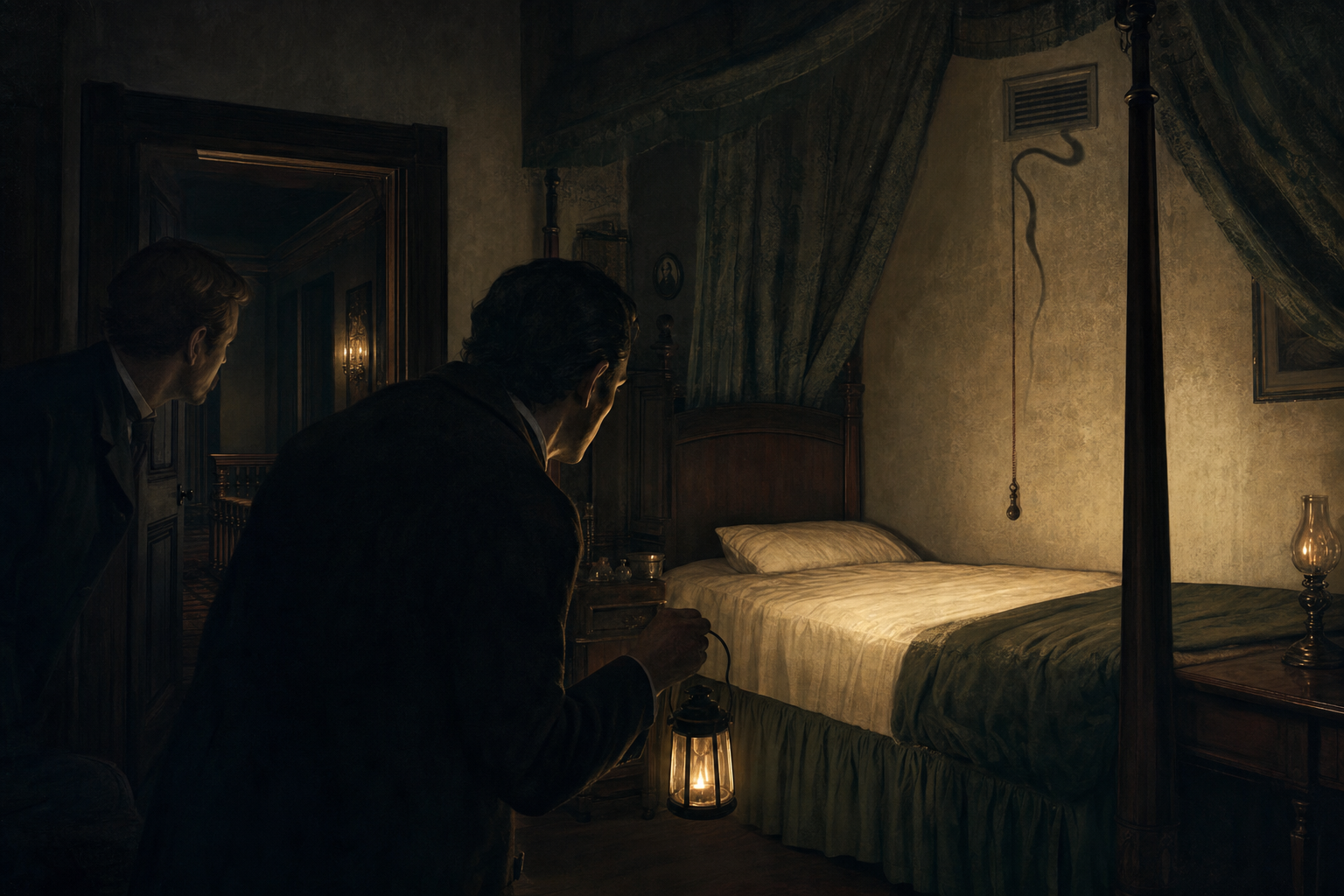
「얼룩 끈」을 읽을 때 환기구, 종줄, 고정된 침대는 각각 따로 보면 이상한 인테리어입니다. 그러나 함께 놓으면 방 전체가 살인 장치가 됩니다. 여기서 close reading은 사물을 목록으로 세는 것이 아니라, 사물들이 하나의 구조를 만들 때 어떤 권력 관계가 드러나는지 설명하는 일입니다. 헬렌의 두려움은 감정적 과장이 아니라, 공간 구조가 증명하는 합리적 공포가 됩니다.
4단계: 결말의 윤리를 평가하기
홈즈가 사건을 해결했다고 해서 윤리 문제가 사라지는 것은 아닙니다. 라이더를 놓아주는 결정, 존 오픈쇼를 구하지 못한 실패, 메리 서덜랜드에게 진실이 닿지 않는 상황은 결말을 더 복잡하게 만듭니다.
이때 "홈즈가 옳다/그르다"로 단순 판정하지 말고, 왜 그 결말이 독자에게 만족감과 불편함을 동시에 주는지 보세요. 「푸른 홍옥」에서 홈즈의 자비는 인간적이지만, 라이더 때문에 무고한 사람이 거의 파멸할 뻔했다는 사실을 지우지 않습니다. 「오렌지 씨앗 다섯 개」에서는 홈즈가 정확히 해석하지만 늦습니다. 이 차이는 추리의 성공과 구조의 실패가 같은 결말 안에 공존할 수 있음을 보여 줍니다.
5단계: 반전이 누구의 해석을 뒤집는지 보기
아이린 애들러는 단순히 홈즈를 이기는 여성이 아닙니다. 그녀는 홈즈의 변장을 읽고, 홈즈가 자신을 읽으려 한다는 사실까지 읽습니다. 「보헤미아 왕국의 스캔들」의 반전은 사진 위치의 반전만이 아니라, 누가 누구를 해석할 권력을 갖는가의 반전입니다. 좋은 답안은 아이린을 "clever woman"으로 칭찬하는 데서 멈추지 않고, 그녀가 왕과 홈즈의 시선에서 벗어나 자기 안전을 설계한다는 점을 분석해야 합니다.
6단계: 빅토리아 시대 전문직 권위를 읽기
홈즈는 단순한 천재가 아니라 근대 전문직 인물처럼 행동합니다. 그는 의사처럼 증상을 읽고, 변호사처럼 증언의 약점을 찾고, 과학자처럼 자료를 기다립니다. 하지만 이 권위는 완전히 중립적이지 않습니다. 「기술자의 엄지손가락」의 해덜리, 「녹주석 왕관」의 은행가 홀더, 경찰, 의사, 탐정은 모두 전문 지식과 사회적 신뢰를 갖지만, 각자의 한계도 드러냅니다. 에세이에서는 professional authority가 문제를 해결하는 힘이면서도 때로 피해를 늦게 읽거나 잘못 읽는 구조라는 점을 함께 다루면 좋습니다.
예시 분석: "You see, but you do not observe"
약한 답안은 이 문장을 "홈즈가 똑똑하다는 뜻"으로만 설명합니다. 강한 답안은 see와 observe의 차이가 독자의 위치까지 바꾼다고 설명합니다. 왓슨과 독자는 같은 계단을 보지만 숫자를 기억하지 못합니다. 도일은 이 차이를 통해 추리소설 읽기 자체가 훈련된 관찰의 게임임을 보여 줍니다.
예시 분석: 「빨간 머리 연맹」의 우스꽝스러운 광고
약한 답안은 "광고가 이상해서 사건이 재미있다"라고 씁니다. 강한 답안은 광고의 우스꽝스러움이 독자의 시선을 머리카락이라는 표면으로 묶어 두는 동안, 실제 범죄는 시간표와 지하 공간에서 진행된다고 설명합니다. 즉 코믹한 오해가 red herring 역할을 하며, 홈즈의 해석은 "무엇이 눈에 띄는가"보다 "누가 그 눈에 띄는 것을 필요로 하는가"를 묻습니다.
예시 분석: 「얼룩 끈」의 방 구조
약한 답안은 "뱀이 무섭다"라고만 말합니다. 강한 답안은 고정된 침대, 가짜 종줄, 통풍구가 함께 읽힐 때 방이 가정적 안전의 공간에서 통제와 폭력의 장치로 바뀐다고 설명합니다. 이 장면은 Gothic danger가 외부 괴물이 아니라 집 안의 권력과 건축 구조에서 나온다는 점을 보여 줍니다.
5. 문학 장치: 셜록 홈즈에서 바로 쓰는 장치 10개
1. Limited First-Person Narration
왓슨의 서술은 정보 접근을 제한합니다. 독자는 홈즈의 결론을 바로 알 수 없기 때문에, 단서를 본 뒤에도 해석을 기다리게 됩니다.
이 장치는 단순한 suspense 장치가 아닙니다. 왓슨은 사건을 인간적으로 만들고, 동시에 독자가 틀릴 수 있는 공간을 만듭니다. "Watson is unreliable"라고 단정하기보다, 왓슨이 정직하지만 부분적으로 이해하는 narrator라고 쓰는 편이 정확합니다. 그의 제한된 시야 덕분에 독자는 홈즈의 설명을 나중에 받으며, 관찰과 해석 사이의 차이를 직접 경험합니다.
2. Clue Patterning
단서는 흩어져 있는 물건이 아니라 나중에 재배열될 패턴입니다. 「얼룩 끈」의 환기구, 종줄, 침대는 따로 보면 이상하지만 함께 보면 장치가 됩니다.
단서 선택을 분석할 때는 "작은 물건이 중요하다"에서 멈추지 마세요. 어떤 단서는 독자를 속이기 위해 화려하고, 어떤 단서는 실제 구조를 설명하기 위해 조용합니다. 「푸른 홍옥」의 낡은 모자는 주인의 계급 하락과 습관을 드러내고, 거위는 보석의 이동 경로를 연결합니다. 좋은 문장은 clue가 plot device이면서 social evidence라고 함께 설명합니다.
3. Disguise and Performance
홈즈, 아이린, 윈디뱅크, 네빌 세인트클레어 모두 정체성을 연기합니다. 변장은 추리 장치이면서 사회적 역할의 불안정성을 보여 줍니다.
특히 「신랑의 정체」와 「입술이 비뚤어진 남자」는 목소리, 글씨, 옷, 얼굴, 장소가 정체성을 만들어 낸다는 점을 보여 줍니다. 변장은 단순한 속임수가 아니라, 빅토리아 사회가 겉모습과 직업을 얼마나 빠르게 믿는지 드러내는 장치입니다. 따라서 disguise를 분석할 때는 "누가 무엇으로 변장했는가"보다 "사회가 왜 그 변장을 믿었는가"를 물어야 합니다.
4. Reversal and Counter-Reading
아이린 애들러는 홈즈의 관찰을 되받아칩니다. 홈즈가 그녀의 집과 반응을 읽는 동안, 그녀도 홈즈의 변장과 의도를 읽습니다.
이 reversal은 첫 단편의 의미를 크게 바꿉니다. 독자는 홈즈가 다른 사람을 해석하는 장면에 익숙해지기도 전에, 홈즈 자신이 해석의 대상이 될 수 있음을 봅니다. 그래서 아이린은 "예외적으로 똑똑한 여성" 정도가 아니라, collection 전체의 관찰 윤리를 시험하는 인물입니다.
5. Comic Misdirection
「빨간 머리 연맹」의 웃긴 설정은 독자를 안전한 농담처럼 느끼게 만듭니다. 그러나 그 농담은 범죄 시간을 벌기 위한 정확한 장치입니다.
comic misdirection은 Doyle이 자주 쓰는 강력한 기술입니다. 이상한 광고, 과도하게 특이한 조건, 우스꽝스러운 의뢰인은 독자의 관심을 표면적 괴상함에 고정합니다. 홈즈는 그 표면을 제거하고 "이 장치가 실제로 무엇을 가능하게 하는가"를 묻습니다. 이 장치를 쓰면 「빨간 머리 연맹」을 단순 퍼즐이 아니라 경제적 욕망과 노동 시간의 이야기로 읽을 수 있습니다.
6. Domestic Gothic
「얼룩 끈」과 「너도밤나무 집」은 오래된 집, 닫힌 방, 가족 권력, 감금의 공포를 사용합니다. 범죄는 거리보다 집 안에서 더 무섭게 나타납니다.
Domestic Gothic의 핵심은 집이 안전한 공간이라는 기대가 무너지는 데 있습니다. 로일롯의 집에서 침대와 통풍구는 보호가 아니라 공격의 통로가 되고, 코퍼 비치스에서 가정교사 일자리는 젊은 여성을 대체 배우로 만드는 감금 계획과 연결됩니다. 이 장치를 분석하면 작품의 공포가 외부 괴물보다 가족 권력, 상속, 결혼 통제에서 나온다는 점을 설명할 수 있습니다.
7. Observation versus Interpretation
홈즈 단편에서 observation은 단순한 시각 경험이 아닙니다. 관찰은 본 것을 기억하고, 분류하고, 다른 사실과 연결해 해석하는 행위입니다.
"You see, but you do not observe"는 이 장치를 압축합니다. 왓슨과 독자는 정보를 봅니다. 홈즈는 그 정보가 왜 의미 있는지 판단합니다. 시험 답안에서는 이 차이를 인물 능력 차이로만 쓰지 말고, 추리소설 독서 방식 자체로 연결하세요. Doyle은 독자에게도 탐정처럼 읽으라고 요구합니다.
8. Victorian Professional Authority
홈즈의 권위는 근대 전문직 권위와 닮았습니다. 그는 의학적 진단처럼 증상을 읽고, 과학자처럼 자료를 요구하며, 변호사처럼 증언의 빈틈을 찾습니다.
하지만 전문직 권위는 항상 완전하지 않습니다. 「기술자의 엄지손가락」에서 전문 기술은 해덜리를 위험한 의뢰로 끌어들이고, 「녹주석 왕관」에서 은행가 홀더의 사회적 권위는 가족 판단을 흐립니다. 홈즈 역시 때로 법 밖에서 판단합니다. 이 장치는 빅토리아 시대의 전문 지식이 문제 해결의 힘이면서 동시에 윤리적 위험을 품는다는 점을 보여 줍니다.
9. Moral Closure
일부 단편은 범인이 벌을 받으며 닫히지만, 일부는 불완전하게 끝납니다. 이 차이를 분석하면 홈즈 세계의 정의관을 더 깊게 읽을 수 있습니다.
「얼룩 끈」은 폭력이 폭력에게 되돌아오는 도덕적 대칭을 제공합니다. 반대로 「오렌지 씨앗 다섯 개」는 해석이 맞아도 의뢰인을 구하지 못하는 실패를 남깁니다. 「푸른 홍옥」은 범인을 놓아주는 결말로 mercy와 justice의 경계를 흔듭니다. 결말을 분석할 때는 "해결되었다"가 아니라 "무엇이 해결되고 무엇이 남는가"를 구분해야 합니다.
10. Cataloguing Detail and Serial Ritual
홈즈는 외양, 옷, 물건, 몸짓을 목록처럼 읽습니다. 이 목록화는 추리를 과학처럼 보이게 하지만, 때로는 당대 편견도 함께 드러냅니다.
베이커가의 시작, 기묘한 의뢰인, 홈즈의 설명, 왓슨의 놀라움이 반복됩니다. 잡지 연재 단편의 리듬이 독서의 안정감을 만듭니다.
이 반복은 얕은 공식이 아니라 serial fiction의 장점입니다. 독자는 익숙한 의식을 통해 베이커가로 돌아오고, 각 사건은 다른 사회적 불안을 시험합니다. 따라서 이 장치를 쓰면 collection-level essay에서 "반복되는 구조가 어떻게 매번 다른 주제--스캔들, 돈, 결혼, 직업, 가정 폭력, 사적 정의--를 다루는가"를 설명할 수 있습니다.
6. 인물 분석을 영어 답안으로 바꾸기
Sherlock Holmes
Method and private judgment
약한 주장: Holmes is smart.
강한 주장: Holmes's intelligence lies in delaying theory until details form a pattern, but his willingness to judge outside the law complicates the collection's idea of justice.
Dr. Watson
Narrative limit and emotional frame
약한 주장: Watson helps Holmes.
강한 주장: Watson's partial understanding lets Doyle turn detection into a reading lesson, because readers share Watson's access to facts without sharing Holmes's disciplined observation.
Irene Adler
Counter-reader
약한 주장: Irene is clever.
강한 주장: Irene Adler matters because she reads Holmes's performance as accurately as he reads others, making the opening story a test of gendered power rather than a simple detective victory.
Helen Stoner
Domestic fear as evidence
약한 주장: Helen is scared.
강한 주장: Helen Stoner's fear becomes credible evidence because Doyle links her testimony to the architecture of the room, exposing domestic authority as a material threat.
7. 주제별 Thesis 만들기
Observation
관찰
약한 thesis: Holmes observes well.
강한 thesis: In The Adventures of Sherlock Holmes, observation becomes a moral discipline because the details society overlooks often reveal the people it has failed to protect.
Disguise
변장
약한 thesis: Many people wear disguises.
강한 thesis: Doyle uses disguise not merely to surprise readers but to show that Victorian identity depends on readable performances of class, gender, occupation, and respectability.
Home
가정
약한 thesis: Some homes are dangerous.
강한 thesis: The collection repeatedly turns domestic interiors into crime scenes, challenging the Victorian ideal of the home as a safe moral refuge.
Justice
정의
약한 thesis: Holmes solves crimes.
강한 thesis: Holmes's solutions expose the difference between discovering truth and achieving justice, especially when legal systems cannot punish coercion, prevent harm, or repair trust.
8. SAT Reading Sample
아래 문제는 공식 College Board 문제가 아니라, 작품 원문과 시험 유형을 바탕으로 만든 SAT Reading 스타일 연습문제입니다. 질문, 보기, Answer: X. 표기는 영어로 두고, 해설은 한국어로 정리했습니다.
Question 1
In the line "You see, but you do not observe," the contrast mainly establishes:
- A. Watson's physical blindness
- B. Holmes's distinction between perception and disciplined attention
- C. the unreliability of all visual evidence
- D. Irene Adler's superiority to the king
Answer: B. 이 문장은 왓슨이 실제로 보지 못한다는 뜻이 아니라, 본 것을 의미 있는 자료로 붙잡지 못한다는 뜻입니다. 시각 증거 전체를 부정하지도 않고, 특정 사건의 우열 판단만 말하지도 않습니다.
Question 2
Holmes's warning against theorising before data most directly criticizes:
- A. scientific vocabulary
- B. newspaper publication
- C. emotional sympathy for clients
- D. conclusions shaped before evidence is gathered
Answer: D. 홈즈는 결론을 먼저 정하면 사실을 거기에 맞추게 된다고 봅니다. 과학 용어 자체나 신문, 감정 이입을 모두 거부하는 말이 아니라 성급한 해석을 경계하는 말입니다.
Question 3
The Red-Headed League's strange copying job functions primarily to:
- A. remove Wilson from his shop while criminals dig below it
- B. test whether Wilson can become a professional writer
- C. help Holmes study encyclopedia style
- D. conceal Irene Adler's photograph
Answer: A. 우스꽝스러운 일자리는 실제 목적을 숨기는 장치입니다. 윌슨이 자리를 비우는 동안 지하 터널 작업이 가능해졌고, 나머지 보기는 사건의 기능과 맞지 않습니다.
Question 4
In "A Case of Identity," Hosmer Angel's typewritten letters help reveal:
- A. a publisher's mistake
- B. Mary's lack of imagination
- C. an attempt to hide handwriting and identity
- D. Holmes's dislike of technology
Answer: C. 타자기는 손글씨를 지워 신원을 숨기는 도구로 쓰입니다. 홈즈는 기술 자체를 싫어하지 않고, 메리의 상상력 부족이 사건의 핵심도 아닙니다.
Question 5
"There is nothing more deceptive than an obvious fact" suggests that obvious facts:
- A. are never true
- B. can stop people from asking better questions
- C. matter only in comic stories
- D. prove the police are always corrupt
Answer: B. 명백한 사실은 때로 너무 편리해서 사고를 멈추게 합니다. 항상 거짓이라는 뜻도, 경찰 전체를 부패로 일반화하는 말도 아닙니다.
Question 6
The failure to save John Openshaw in "The Five Orange Pips" complicates Holmes by showing that:
- A. he refuses to read letters
- B. Watson invents all the cases
- C. all American references are comic
- D. correct interpretation may arrive too late to prevent harm
Answer: D. 홈즈는 위협을 이해하지만 의뢰인을 구하지 못합니다. 이 실패는 추리와 구조 사이의 시간차를 보여 주며, 홈즈를 전능한 해결사로만 볼 수 없게 합니다.
Question 7
Neville St. Clair's double life most strongly develops the theme of:
- A. identity as social performance
- B. childhood education
- C. royal marriage
- D. supernatural punishment
Answer: A. 그는 존경받는 가장과 거리의 거지라는 두 역할을 연기합니다. 사건의 핵심은 초자연이나 왕실 문제가 아니라 옷, 얼굴, 장소가 정체성을 바꾸는 방식입니다.
Question 8
Holmes's decision to release Ryder in "The Blue Carbuncle" is best read as:
- A. proof that theft is harmless
- B. a rejection of all evidence
- C. an act of private judgment that may be morally debated
- D. a legal requirement in Victorian courts
Answer: C. 홈즈는 범인을 알면서도 자비를 선택합니다. 그 선택은 인간적이지만, 무고한 사람이 피해를 입을 뻔했다는 점 때문에 논쟁적입니다.
Question 9
In "The Speckled Band," the fixed bed, false bell-pull, and ventilator are important because they:
- A. decorate an old country house
- B. show Helen dislikes modern furniture
- C. prove Watson designed the room
- D. form a physical system for Roylott's murder plan
Answer: D. 세 물건은 각각 이상한 장식처럼 보이지만 함께 읽으면 범죄 장치가 됩니다. 홈즈의 추리는 방 구조를 하나의 문장처럼 읽는 과정입니다.
Question 10
The phrase "Violence does, in truth, recoil upon the violent" gives "The Speckled Band" a tone of:
- A. comic misunderstanding
- B. moral consequence
- C. romantic nostalgia
- D. scientific neutrality
Answer: B. 폭력이 폭력의 주체에게 돌아온다는 문장은 도덕적 인과응보의 느낌을 줍니다. 희극적 오해나 낭만적 회상보다 결말의 윤리적 정리를 강조합니다.
Question 11
Victor Hatherley's injury in "The Engineer's Thumb" emphasizes:
- A. the bodily cost of industrial crime
- B. the safety of secret employment
- C. Holmes's complete control over events
- D. the disappearance of all technology
Answer: A. 이 사건은 기계와 전문 기술이 범죄에 이용될 때 피해가 실제 신체 손상으로 나타난다는 점을 보여 줍니다. 홈즈가 모든 것을 통제하지도 못합니다.
Question 12
The missing bride in "The Noble Bachelor" is not primarily a murder victim but:
- A. a detective in disguise
- B. a servant escaping theft charges
- C. a woman returning to a prior emotional bond
- D. a witness to a bank robbery
Answer: C. 해티는 납치되거나 살해된 것이 아니라 죽었다고 믿었던 프랭크와 재회합니다. 사건은 범죄 음모보다 결혼과 감정의 충돌에 가깝습니다.
Question 13
Arthur Holder's silence in "The Beryl Coronet" mainly shows that silence can indicate:
- A. automatic guilt
- B. protective loyalty and misplaced sacrifice
- C. lack of family feeling
- D. Holmes's narrative absence
Answer: B. 아서는 자신이 범인이라서 침묵하는 것이 아니라 메리를 보호하려 합니다. 홈즈는 침묵을 곧바로 죄로 연결하지 않고 동기를 다시 읽습니다.
Question 14
Violet Hunter's role in "The Copper Beeches" is important because she:
- A. ignores every suspicious sign
- B. replaces Watson as permanent narrator
- C. causes the crime for money
- D. observes danger and seeks help before being trapped
Answer: D. 바이올렛은 수동적 피해자만이 아니라 이상한 조건을 기록하고 판단하는 인물입니다. 그녀의 관찰이 사건 해결의 출발점이 됩니다.
Question 15
Across the collection, Watson's narration usually makes readers:
- A. share limited information before Holmes explains the pattern
- B. know the solution before the client arrives
- C. distrust every event as a dream
- D. ignore the emotional stakes of the cases
Answer: A. 왓슨은 독자를 사건 안으로 데려가지만 홈즈의 전체 해석은 늦게 줍니다. 그래서 독자는 단서를 함께 보면서도 결론은 나중에 이해합니다.
Question 16
Which detail best supports the idea that domestic spaces can become crime scenes?
- A. Holmes's fondness for concerts
- B. Watson's medical background
- C. the ventilator and fixed bed in Helen Stoner's room
- D. the encyclopedia in the League office
Answer: C. 헬렌의 방 구조는 가정 내부가 안전한 공간이 아니라 살인의 장치가 될 수 있음을 보여 줍니다. 다른 보기는 주제와 직접 연결되지 않습니다.
Question 17
The recurring use of disguises suggests that Victorian identity is:
- A. easily read through performance, clothing, voice, and social role
- B. always biologically fixed
- C. unrelated to class
- D. impossible for Holmes to interpret
Answer: A. 여러 사건에서 사람들은 목소리, 옷, 직업, 외모로 자신을 다르게 읽히게 만듭니다. 도일은 사회가 이런 표지를 얼마나 쉽게 믿는지 보여 줍니다.
Question 18
The collection's magazine-story structure most affects the reading experience by:
- A. eliminating all repetition
- B. creating a recognizable ritual of client, clue, investigation, explanation
- C. preventing Watson from narrating
- D. making every case part of one continuous trial
Answer: B. 연재 단편은 반복되는 틀을 통해 안정적인 독서 리듬을 만듭니다. 매번 의뢰와 단서, 조사와 설명이 변주되며 독자는 그 형식을 기대하게 됩니다.
Question 19
When Holmes says he cannot make bricks without clay, the metaphor implies:
- A. deduction requires raw evidentiary material
- B. architecture is the only subject of detection
- C. Watson should become a builder
- D. clients always lie for profit
Answer: A. 진흙 없이 벽돌을 만들 수 없다는 말은 자료 없이 추리를 완성할 수 없다는 뜻입니다. 특정 직업이나 모든 의뢰인의 거짓말을 말하는 비유가 아닙니다.
Question 20
The best description of Holmes's justice across the collection is that it is:
- A. always identical to court punishment
- B. purely accidental and never reasoned
- C. brilliant at revealing truth but uneven in legal or social repair
- D. unrelated to moral questions
Answer: C. 홈즈는 진실을 자주 밝히지만, 처벌과 회복은 사건마다 다릅니다. 어떤 피해자는 구하지 못하고, 어떤 범인은 놓아주며, 어떤 가족은 완전히 회복되지 않습니다.
9. AP Lit Essay Questions
Essay Question 1
Analyze how Doyle uses Watson's limited narration to shape suspense and meaning in two or more stories.
Essay Question 2
Discuss how "A Scandal in Bohemia" complicates Holmes's authority through Irene Adler's counter-performance.
Essay Question 3
Choose one object from the collection, such as a hat, bell-pull, photograph, typewritten letter, or goose, and explain how it becomes evidence.
Essay Question 4
Analyze the role of domestic space in "The Speckled Band" and "The Copper Beeches."
Essay Question 5
How does Doyle turn comic absurdity into criminal logic in "The Red-Headed League"?
Essay Question 6
Compare two cases in which disguise reveals anxieties about class or gender.
Essay Question 7
Evaluate Holmes's private judgment in "The Blue Carbuncle." Does the story present mercy as justice, or as an escape from justice?
Essay Question 8
Analyze how delayed interpretation structures reader experience across the collection.
Essay Question 9
Discuss the ethical significance of Holmes's failure in "The Five Orange Pips."
Essay Question 10
How does Doyle use professional expertise, such as medicine, engineering, banking, or detection, to define modern authority?
Essay Question 11
Analyze one female client as an observer rather than a passive victim.
Essay Question 12
Compare the treatment of marriage in "A Case of Identity," "The Noble Bachelor," and "The Copper Beeches."
Essay Question 13
Explain how obviousness functions as a trap in one or more cases.
Essay Question 14
Discuss how the collection uses London and the countryside as different but connected spaces of danger.
Essay Question 15
Analyze the relationship between economic pressure and crime in at least two stories.
Essay Question 16
How does Doyle make Holmes's method appear scientific while keeping the stories dramatic?
Essay Question 17
Choose one story with an incomplete or morally uneasy ending and explain how that ending affects the collection's idea of justice.
Essay Question 18
Analyze how repeated formulas in the collection create pleasure rather than simple predictability.
Essay Question 19
Discuss how material details reveal hidden social relationships.
Essay Question 20
How does The Adventures of Sherlock Holmes help establish conventions later detective fiction inherits or revises?
10. 모델 Thesis Bank
- Doyle uses Watson's limited narration to make detection feel like a reading lesson: readers possess many of the same facts Watson does, but they must learn why Holmes assigns those facts different weight.
- Irene Adler's success in "A Scandal in Bohemia" matters because it turns the first case into a contest over interpretation, gendered power, and self-protection rather than a simple royal rescue.
- In "The Red-Headed League," absurdity is not decoration but camouflage; Doyle makes the ridiculous job logical once readers ask who profits from Wilson's absence.
- "The Speckled Band" transforms a bedroom into a crime mechanism, showing that domestic architecture can encode power, fear, and violence.
- Holmes's mercy in "The Blue Carbuncle" reveals both the appeal and danger of private justice, because his humane reading of Ryder bypasses the innocent man's near-destruction.
- Across the collection, disguise exposes Victorian respectability as a performance maintained through clothes, voice, occupation, and the management of public appearances.
- The failure in "The Five Orange Pips" prevents Holmes from becoming a fantasy of total control and makes timing part of the collection's moral structure.
- Violet Hunter's alertness in "The Copper Beeches" shows that detection often begins before Holmes arrives, when a vulnerable person refuses to dismiss her own observations.
- Doyle's recurring emphasis on data makes Holmes sound scientific, but the stories also show that evidence becomes meaningful only when read inside social context.
- The collection's repeated case structure creates ritual pleasure while allowing each story to test a different anxiety: scandal, money, marriage, domestic danger, professional risk, or failed justice.
- Watson's narrative limitation is not a flaw in the collection but its central teaching device, because his partial perception lets readers experience the difference between seeing a clue and assigning it interpretive value.
- "The Five Orange Pips" disrupts the usual detective-story satisfaction by making Holmes's correct reading arrive too late, thereby separating intellectual success from moral rescue.
- "A Case of Identity" turns romance into coercion by showing how typewritten letters, altered voice, and sentimental promises can become tools for economic confinement.
- In "The Man with the Twisted Lip," St. Clair's double life reveals that class identity depends on public signs that can be manufactured, rented, dirtied, cleaned, and performed.
- "The Beryl Coronet" uses Arthur's silence to challenge the assumption that refusal to speak equals guilt, making interpretation depend on motive rather than surface behavior.
- Doyle's domestic cases show that Victorian homes can hide systems of surveillance and control, so detection requires reading architecture, furniture, and household routines as evidence.
- "The Noble Bachelor" lowers the temperature of mystery in order to expose marriage as a social contract shaped by rank, money, reputation, and prior emotional obligation.
- Holmes's release of Ryder in "The Blue Carbuncle" complicates the collection's ethics because mercy appears generous only if readers overlook the innocent man nearly destroyed by Ryder's theft.
- The collection's repeated movement from bizarre surface to practical motive suggests that eccentric details in detective fiction are rarely ornamental; they are pressure points where social desire becomes visible.
- Across the twelve stories, Doyle makes detection a form of social reading, since clues disclose not only individual guilt but also the class, gender, and economic systems that make deception possible.
11. 에세이용 학술 어휘
- observation: 단순히 보는 것이 아니라 의미 있는 세부를 선택하고 기억하는 행위
- inference: 직접 말하지 않은 결론을 증거로부터 끌어내는 해석
- red herring: 독자를 잘못된 방향으로 이끄는 단서
- disguise: 정체성을 숨기거나 조작하는 외양과 행동
- narrative delay: 결론이나 핵심 정보를 늦게 제시해 긴장을 만드는 방식
- domestic Gothic: 집과 가족 공간을 공포와 억압의 장소로 바꾸는 장르적 장치
- private justice: 공적 법 절차가 아니라 인물의 판단으로 이루어지는 정의
- social performance: 계급, 성별, 직업, 체면을 몸짓과 언어로 연기하는 방식
12. 본문 글 다시보기
전체 12편 줄거리와 컬렉션 해설은 본문 글에서 다시 볼 수 있습니다.